

By Natalie Simms, LL’12, gcLi Scholar ‘15, Lower School Teacher, Brownell-Talbot School (NE)
It’s 7:55 a.m. The morning bell rings, and I imagine a curtain lifting while I stride to my classroom’s doorway to meet the children who humble me on a daily basis. As I welcome each student to class, I’m reminded that the script will likely be improvised today; there will be scene changes, edits, and character revisions. There may be a plot twist, an unforgettable monologue, a surprise ending. The show must go on, however, because I’m surrounded by children under the age of ten who have no idea how much leadership potential they possess. And it’s my job to direct them to not only find it, but to use it to bring positive change to their communities.
SCENE ONE- SETTING THE STAGE
“Leaders can either be controlling and determined to get their way at any cost, or they can be open and selfless and willing to adjust to what others might need, which is what you did. You taught the side of leadership where asking for help was okay and listening to suggestions and inputs was important.”
– McKayla, current high school senior, former Kindergarten student
The question I most often receive about teaching leadership in an elementary classroom is: “How do you do it?” In its simplest form, the answer to that question is to listen.
I began my teaching adventure at Berryhill Elementary School in Charlotte, NC. Every morning, as I walked through the doors to begin my day in Kindergarten, our principal, Mr. Pratt, would stand in the entryway and greet all students and teachers who walked through those doors. What resonated with me is the genuine care with which Mr. Pratt treated each and every one of these small exchanges. He truly listened to what his teachers and students shared. He remembered past conversations and followed up on them. There wasn’t a student or teacher who left those morning conversations without a smile. I began to attempt to emulate this leadership style in my classroom. My reasoning was that if every child felt as regarded as I did, my students would feel comfortable taking risks and admitting the need for help and would feel confident suggesting new strategies or providing feedback.
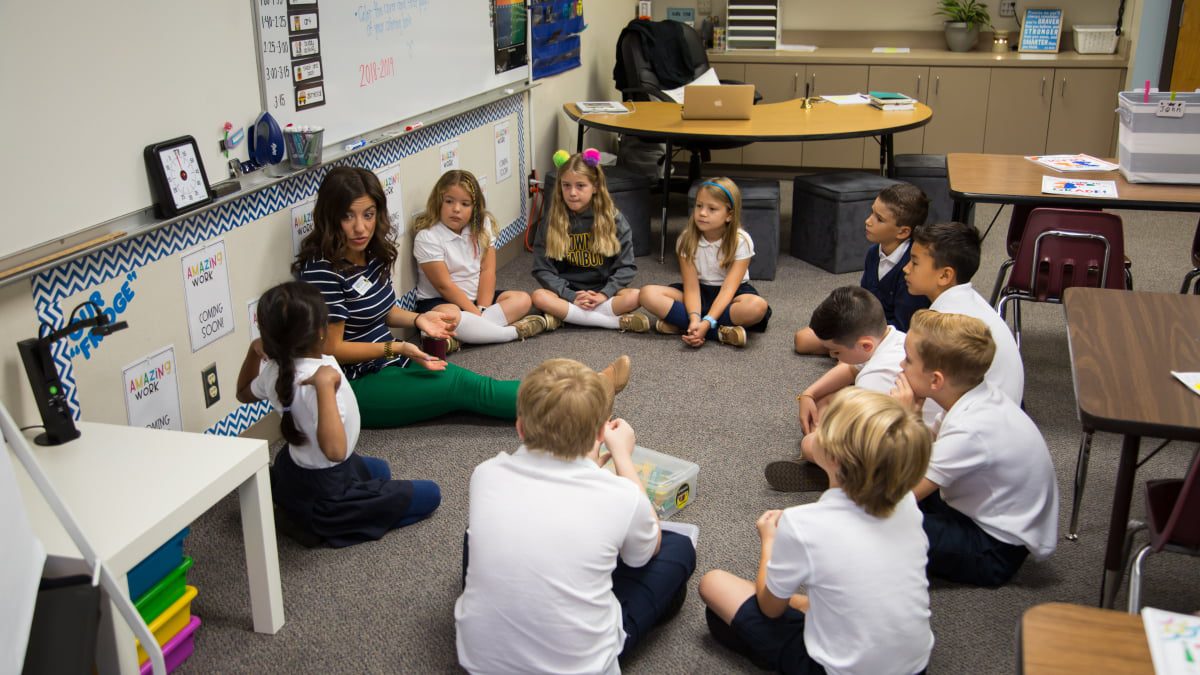
Each day, my class begins the day with a Morning Meeting (from Responsive Classroom) that I’ve tailored to fit our class’ needs. We greet each other and share what’s happening in our lives or answer a fun question that helps us learn more about each other. I begin each lesson with a small explanation of what I hope we can accomplish together, and I end each lesson or unit with time for students to share honest feedback on what went well and how it could be improved. I allow students to share strategies that are different from mine. (I can’t tell you how many new math strategies I’ve learned just by calling on a raised hand!) I ask what the thought process was when someone gets something wrong. I ask how students are feeling, and I’m flexible with most facets of our day being based upon their feelings. And, when students have ideas for how they can activate change, I become their champion, their ally, and their encourager.
My schedule might change, the order in which we do things might change, and I might simply provide “Do What’s Good for Your Heart” time, a time when I’m willing to table something in our schedule so that my students can catch up on work, practice mindfulness, or just be. In my opinion, schools should find as many opportunities as possible to include their children’s perspectives. It’s not always easy, and there are days when we don’t accomplish everything on the to-do list, but making certain students feel listened to and have a sense of belonging is one of the most important lessons in leadership I can offer.
SCENE TWO- THE SCRIPT
“Leaders are very passionate people. They have to think differently – outside the box. They have to make tough decisions. They want change. Most of them have a backstory – a story maybe from when they were younger. It is in these stories AND wonderings that motivated them to do what they did – to work hard on something they felt was important and needed care.”
– Sal, current 4th grader, past 2nd grader
As humans, we connect to stories. Stories, whether verbal, written, acted out, or dreamed can become the catalyst for learning. Throughout the entire year, but especially at the beginning, I share with my students that it will benefit them to pay attention to how their year’s story unfolds; that it’s possible that a particular art class will lead them to find their passion, that a new friend may become a best friend, that a risk taken may help conquer a fear. I try to help them see that each day is a new page in their own stories, and that they have the power to write them.
When students are presented with the analogy of creating a story, I’ve often found that they are motivated to do their best to write it the way they would want it written rather than giving others the power to write their own story. In addition to writing personal stories, we write our class story. We brainstorm what type of story we hope to have at the end of the year. Most often, it is a story of hope or accomplishment. As the year progresses, I remind our class to write its story of overcoming obstacles, of taking risks, of empowering and supporting each other.
SCENE THREE- THE THEME
“What I was taught about leadership is, still do stuff, even when stuff is hard. Sometimes I feel like I should quit, but now I try harder/ longer.”
– Amelia, current 4th grader, past 3rd grader
There will come a day when teaching leadership to your elementary students feels impossible. Own it, and not at home, in the safety of your own interrogations; own it, with the kids, in front of them. Admit your failures, and acknowledge when things don’t go according to your plan. Share why. Make a plan to try again. One of the most valuable lessons you can give to your students is living by example. Failure is inevitable, and in fact, is often when one finds inspiration. Children need to feel comfortable failing so that they can use the experience as a learning tool. There is no better person to guide them to this understanding than the person who determines what failure and success looks like in their classroom.
“My daily mantra became ‘choose your battles’.”
– Cameron, current 4th grader, past 3rd grader
“Stand up for other people, and help.”
– Donovan, current 4th grader, past 2nd grader
There is no greater battle than the battle for what is best for your students. Choose what will encourage them to activate change. Choose what will inspire them to challenge the status quo. Choose to teach through different perspectives. Choose what will honor them. Choose to lead by example, and help others see that elementary students are capable of learning about leadership.
It’s 3:15. The hugs and high-fives cease, and the curtain closes. I take a final look at today’s script: it’s nothing like it looked at the beginning of the rehearsal. But somehow, despite all it’s been through in a day, it’s just a bit better than the day before. And when tomorrow’s rehearsal time comes, the new script will face the same fate. Each day, our students rehearse for the show called Life. As elementary teachers, we can give them the opportunity to rehearse and grow before being called on stage in middle and high school.
Natalie Simms is an elementary educator with experience that spans both public and independent schools in states that include New Jersey, North Carolina, Texas, California, Oregon and Nebraska. Throughout her career, she has taught kindergarten and second through fifth grades. Natalie has her M.Ed. and Master Reading Teacher certification from Southern Methodist University, and a B.S. in Elementary Education and B.A. in Math/Science from Rowan University. Natalie has a deep passion for teaching leadership in elementary classrooms and has been a presenter and Scholar for the Gardner Carney Leadership Institute. In her spare time, Natalie enjoys traveling with her husband, Tom, running, and reading.