
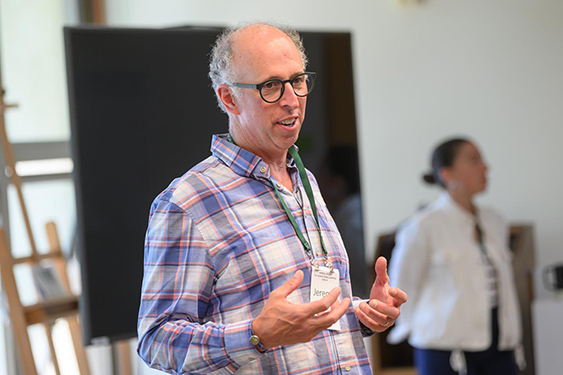
By Jeremy LaCasse, Director, gcLi, Associate Head of School, Mercersburg Academy, Mercersburg, PA
The Gardner Carney Leadership Institute hosted its 22nd annual Leadership Lab at the Stevenson School in Pebble Beach, CA in June. Being our 22nd iteration, I am reminded of a saying, “be wary of the teacher who claims to have had twenty years of experience. They may have one year of experience twenty times!” In the case of the gcLi Leadership Lab, I am so mindful of the iterative process of both the Lab and of teaching leadership. Both require a willingness to create learning experiences and to draw feedback from the group about the nature of the experience and the outcomes resulting from the shared work.
In this version, we navigated the challenge of being in a new place and the logistics and mechanics that go with that. We also shifted from working closely with Fountain Valley School to becoming a division of CSEE. In both cases, we needed to learn as we led to meet our mission and deliver an experience that allowed our participants to develop an understanding and enhance their practice of the Pedagogy of Leadership®.
The most important lessons we have learned concern how we help teachers to teach leadership to students. From where we started in 2005, we have learned much and each lesson marks a moment in time, not necessarily a riddle solved or a formula engaged. Instead, we have learned about how to create a framework within which a group navigates a challenge that creates the necessary learning. While the gcLi currently defines leadership as entailing being aware of whatever is happening around you and choosing behaviors, from a place of empathy and courage, that help your group to achieve its goals, we might consider a revision that incorporates a greater understanding of belonging and inclusion, and collective genius. This is but one example of how our increasing knowledge and experience require us to shift our understanding and, by extension, our practice.
Leading and the teaching of leadership are messy and uncertain affairs with many and sometimes conflicting variables. At the Lab this year, we had 57 participants, one scholar, and nine faculty members. This group had never been together in this form or for this purpose. While the entire group agreed to the general premise of the group and the overarching goals, with each experience, exercise, and piece of information, we invited an opportunity for confusion, disagreement, conflict, and challenge. How we helped the individuals of the group feel that they mattered to the work of the group, that they could bring their whole self to the shared work, and that we could together do something meaningful and important is central to the Pedagogy of Leadership®.
We have learned that we need to help the members of the group understand, in a metacognitive sense, what is happening in the group and how their and others’ actions are influencing the ability of the group to engage in critical learning. Groups often have conflicts about how they will go about solving problems. Even more challenging is when members realize the gap between their intended impact and their actual impact—especially when their actions hinder the group’s progress.
These are some of the most critical moments in teaching an individual to lead. To reference the gcLi definition of leadership, accurate self and situational awareness is essential to leading. Separating ourselves and our self-image from the impact of our actions can be a painful experience, particularly when the effect of our actions differs from our intent.
The gcLi Leadership Lab ‘26 drove home this concept and helped both faculty and participants see this in action. This happened most essentially through the shared-problem solving and experience of the participants, guided, facilitated and structured by the faculty. The faculty utilized both the design and the capacity to be flexible in its application to aid in that learning. According to our annual post-Lab survey, more than 91% of participants noted that the Lab helped them gain the knowledge and learning both they and we hoped they would, suggesting that the design and its implementation continues to provide essential learning to our participants.
As we look to next year and the LL ‘27, we will continue to consider the feedback we have received, the needs of future groups, and how we, as a faculty, can continue to learn so as to best serve the learning of our participants and, by extension, the learning of their students. Leadership and its teaching remains an essential need across all levels of education and beyond. We look forward to supporting the great work of our graduates and hearing of the impact their work has on their students. Each year, we note why teaching leadership is so critical for this moment and the future and the sentiment seems to become even more essential each year. Thank you to all of the teachers who do their best to help create strong and capable leaders for our shared future.
———————————
Jeremy LaCasse serves as the Director of The Gardner Carney Leadership Institute. He held the Shotwell Chair for Leadership and Character Development at Berkshire School, where he also directed the Ritt Kellogg Mountain Program, served as Dean of the Sixth and Fourth Forms, taught European and Medieval history, and coached the ski and crew programs. Following his time at Berkshire, he served as Dean of Students at Fountain Valley School of Colorado. He subsequently served as Head of Senior School at Shady Side Academy in Pittsburgh, PA; Head of School at Kents Hill School in Kents Hill, ME; Assistant Head of School at Cheshire Academy in Cheshire, CT; and Assistant Head of School at The Taft School in Watertown, CT. He graduated with a B.A. in History from Bowdoin College in Brunswick, Maine, and earned an M.A. in Private School Leadership from the Klingenstein Center at Teachers College, Columbia University.